The Secret Ingredient in Grandma's Recipe Is Grandma — And Food Science Can Actually Explain That
The Secret Ingredient in Grandma's Recipe Is Grandma — And Food Science Can Actually Explain That
Every family has one. A dish so specific to one person that attempting to recreate it feels almost disrespectful — like trying to forge someone's signature. Maybe it's your grandmother's red sauce, or your dad's ribs, or your aunt's sweet potato pie that only appears at Thanksgiving and is somehow better than anything you've eaten all year.
You've tried to make it yourself. You got the recipe — or what passes for a recipe, scrawled on a notecard in handwriting that abbreviates everything and assumes you already know things you don't. You bought the same brand of tomatoes. You used her pot. You followed every step.
And it was good. Maybe even really good. But it wasn't that.
This is one of the most universal experiences in food, and it turns out there are real, documented reasons why it happens. Some of them are practical. Some of them are psychological. And at least one of them is genuinely kind of beautiful.
The Recipe Was Never the Whole Story
Let's start with the obvious problem: handwritten family recipes are famously incomplete.
"A handful of salt" is not a unit of measurement. Neither is "cook until it smells right" or "hot enough" or the deeply unhelpful "you'll know when it's done." These instructions aren't vague because the cook was being careless — they're vague because the cook doesn't need to write down what they already know in their hands and nose and years of muscle memory.
Food scientists call this tacit knowledge — the kind of expertise that's so deeply embedded in practice that it becomes nearly impossible to articulate. Your grandmother doesn't think about how hard she's stirring the roux, or exactly when she turns the heat down, or how long she lets the onions go before adding the garlic. She just knows. And that knowledge, accumulated over decades of making the same dish, is genuinely irreproducible from a notecard.
A professional chef would call it technique. A neuroscientist might call it procedural memory. Either way, it doesn't transfer through a recipe.
Your Brain Is Doing Something Wild With That Flavor
Here's where it gets interesting. Even if you somehow replicated every variable perfectly — the same ingredients, the same technique, the same timing — there's a solid scientific argument that it still wouldn't taste the same to you.
That's because flavor is not just a chemical event happening on your tongue. It's a full-brain experience, and memory is deeply wired into it.
Researchers in sensory psychology have documented what's sometimes called nostalgia-driven taste bias — the measurable phenomenon where emotional context changes how we perceive flavor. When we eat something connected to a powerful memory, the brain doesn't just process the taste. It layers in the emotional residue of every previous time we've eaten that thing. The warmth of the kitchen. The sound of a football game in the background. The specific feeling of being twelve years old and having nowhere to be.
This isn't sentiment. It's neuroscience. The limbic system, which governs both emotion and memory, is directly connected to the olfactory system — our sense of smell, which is the most powerful trigger of autobiographical memory we have. The smell of that red sauce hits the same neural pathways as the memory of who you were when you first ate it. You're not just tasting the food. You're tasting the context.
Which means when you make it yourself, in your own kitchen, without her there — the context is different. And so, inevitably, is the experience.
The Cook Is an Ingredient
There's a phrase that floats around in food writing that sounds poetic but is actually quite literal: the cook is an ingredient.
Think about what that means practically. Two people making the same soup will stir it differently, taste it at different points, add a little more of this, hold back on that. One person runs hot and keeps the burner higher than the recipe suggests. Another is cautious, always pulling back. These micro-decisions, made intuitively and without much conscious thought, compound over the course of an hour of cooking into something genuinely different.
And then there's the question of care — which sounds soft until you consider that cooking with attention and intention produces measurably different results than cooking on autopilot. A cook who tastes as they go, adjusts constantly, and has a specific person in mind while they're making something is simply going to make something different than a cook who's trying to replicate a dish from memory while also answering texts.
Your grandmother wasn't just executing a recipe. She was cooking for you, with the particular attentiveness that comes from loving someone.
What This Means for the Recipes We're Trying to Save
There's a bittersweet undercurrent to all of this, especially for families who've lost someone whose cooking was irreplaceable. The dish can't be perfectly recreated. The science is pretty clear on that.
But here's what can happen: over time, your version of it becomes its own thing. You make it enough times that your hands learn it. Your kitchen starts to smell like it. The people you feed it to build their own memories around your version. The recipe doesn't die — it evolves, the way it always has, carried forward by whoever picks it up next.
That's actually how most of the dishes we think of as "traditional" came to exist. Someone's grandmother adapted her mother's version, who adapted it from hers, each generation leaving their handprint on it.
Cook With Her, If You Still Can
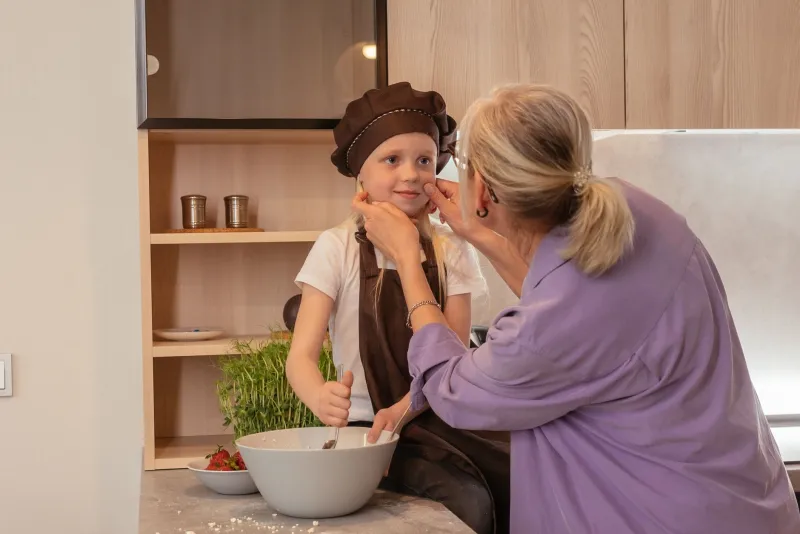
If there's one practical takeaway from all of this, it's this: if the person whose cooking you're trying to learn is still around, cook with them. Not just nearby. Actually in the kitchen, watching their hands, asking questions they've never been asked before.
How hard are you stirring that? What does "done" smell like to you? How do you know when the oil is ready?
Those answers won't fit on a notecard. But they'll live in your hands for the rest of your life. And someday, someone might taste your version and say it's not quite the same — and mean it as the highest possible compliment.